What is Dry Needling?
Dry needling is a treatment used by qualified health professionals to target muscle pain, tightness and stiffness. It is a technique that uses a thin, sterile filiform needle that is inserted into a specific trigger point which can contribute to pain or restricted movement with the aim of restoring function.1
Dry needling works really well for myofascial pain and trigger points which are tight, knotted muscles that can form as a result of injury, overuse, poor posture or stress. The goals of dry needling are to release muscle tension, pain, improve blood flow around the region and promote healing in the affected areas.1,2
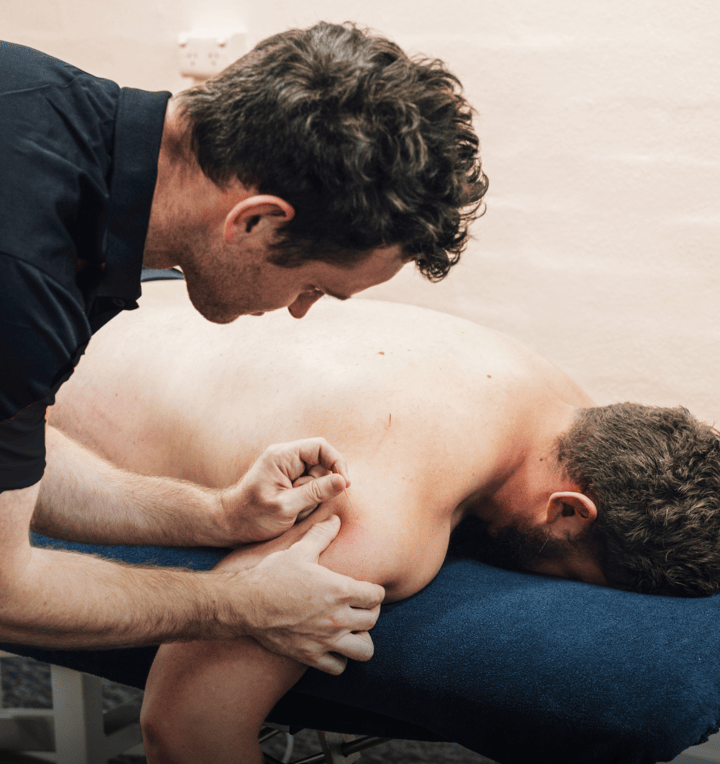
HOW DOES DRY NEEDLING WORK
A taut band develops in the muscle due to overload, trauma, stress or other factors which creates an inhibition of an enzyme, acetylcholinesterase, which breaks down acetylcholine. As a result there is an increase of acetylcholine which leads to an increased release of calcium causing a sustained contraction leading to the formation of a taut band. Dry needling the trigger points on the taut band looks to release acetylcholine which then relaxes the muscle.1,2
When the needle is inserted into a trigger point, it stimulates the muscle and surrounding tissues which can trigger a muscle twitch. A local twitch response is a very brief, sometimes painful contraction of a taut band in the skeletal muscle and is when the needling is most effective. However, the twitch response also contributes to post-needling soreness. The twitch response is thought to help reset the muscle, promoting better blood flow, and breaking the cycle of pain and tension in the muscle.
Twitch responses are generally elicited by the Hong technique, where the needle is repeatedly moved up and down in the muscle quickly. This technique is mainly used in patients with subacute or recurrent pain and not recommended for chronic pain to avoid the post-needling soreness.
Due to the sustained contraction of the muscle, it causes a capillary constriction resulting in decreased energy supply. Due to the ongoing contraction, however, the muscle needs a lot of energy which leads to an imbalance. The reduced energy supply in combination with the increased energy demand results in an energy crisis and as a result, inflammatory mediators are disturbed. Therefore, dry needling plays an important role on pain, inflammation and blood flow around the muscle and trigger points.3, 4
Therefore needling works to:
Increase blood flow to the area, which accelerates the healing process
Releasing muscle tightness and improving the range of motion
Altering the pain response by stimulating nerve pathways that may reduce the sensation of pain in the muscle or surrounding areas
Reducing inflammation by changing the imbalance or energy levels in the muscle which can help with chronic pain conditions
WHEN IS DRY NEEDLING USED?
Dry needling may be an effective treatment for individuals experiencing muscle pain, stiffness, and tension, particularly when traditional methods like stretching, massage, or medications have not provided sufficient relief. 1-4
It is commonly used to treat a variety of conditions involving musculoskeletal pain and dysfunction, including but not limited to:
Myofascial pain: muscle pain caused by the formation of trigger points in muscles.
Chronic muscle pain and stiffness: pain from conditions like fibromyalgia, tension headaches and general muscle tightness.
Sports injuries: athletes may benefit from dry needling to treat muscle strains, overuse injuries, and other soft tissue injuries.
Neck and back pain: dry needling is often used for chronic neck pain, lower back pain, and tension in the upper back and shoulders.
Joint pain: although primarily targeting muscles, dry needling can also help reduce pain around joints and improve movement in the affected area.
Tendonitis: dry needling can assist with conditions like Achilles tendinopathy, lateral epicondylalgia or rotator cuff tendonitis.
Muscle spasms: when muscles are in a spasm, dry needling can help relax the muscles and promote greater range and less pain
Dry needling mainly has a short-term effect similar to massage. For this reason, it should be seen as a tool in the early phase of treatment to change the pain and provide some relief before strengthening the region. Moreover, dry needling should not be seen as a standalone therapy and needs to be part of a comprehensive treatment plan including exercises and lifestyle modifications.
BENEFITS OF DRY NEEDLING
Dry needling offers a number of benefits for those struggling with musculoskeletal pain, including: 5,6
Targeted Pain Relief: Dry needling can provide immediate relief from pain by targeting the source of muscle tension directly. For many patients, this relief is long-lasting, especially when combined with other treatments like physical therapy.
Improved Range of Motion: By releasing muscle tightness and reducing pain, dry needling can help restore mobility in joints and muscles, making it easier to perform daily tasks and physical activities.
Reduced Muscle Tension: Dry needling is highly effective in treating areas of muscle tightness, allowing the muscle to return to a more relaxed state. This can be particularly beneficial for individuals with chronic tension, such as those who experience frequent headaches or neck pain.
Promotes Healing: The increase in blood flow and circulation resulting from dry needling helps facilitate tissue repair, making it a helpful adjunct in the recovery process for acute injuries or post-surgical rehabilitation.
Non-Invasive: Unlike some other treatments for pain relief, dry needling is non-invasive, with minimal risk of side effects. It is an attractive option for patients who want to avoid medication or surgery.
Complementary Treatment: Dry needling works well when combined with other therapies such as physical therapy, massage or other modalities for a comprehensive approach to the pain.
SIDE EFFECTS OF DRY NEEDLING
Dry needling has some potential side effects which include:
Pneumothorax: When needling around the mid back and lungs there is a risk of a pneumothorax which is reduced by the adequate training and technique.
Minor soreness: Some muscle soreness is common after treatment, but this usually resolves quickly.
Bruising: Mild bruising can occur at the needle insertion sites.
Dizziness or fainting: Although rare, some people may feel lightheaded or faint during or after treatment.
Infection: As with any procedure involving needles, there is a slight risk of infection, but this is minimized with proper hygiene and sterile needles.
Bleeding: Some mild bleeding can occur at the needle insertion sites but is easily resolved with firm pressure
WHEN SHOULD I AVOID DRY NEEDLING
Dry needling is not recommended for certain individuals, such as:
Pregnancy: Pregnant women should consult with their healthcare provider before trying dry needling, especially during the first trimester. While some pregnant women may safely receive treatment, certain precautions may be necessary to ensure the safety of both the mother and the baby.
Bleeding Disorders: Individuals with bleeding disorders or those taking blood-thinning medications should be cautious when considering dry needling. The risk of bleeding or bruising may be higher in these cases.
Skin Infections or Lesions: If you have an active skin infection or lesion at the site where dry needling is intended, it’s best to avoid treatment until the area has healed to prevent complications.
HOW IS DRY NEEDLING DIFFERENT TO ACUPUNCTURE
Dry needling is not the same as acupuncture. While acupuncture is based on traditional Chinese medicine and involves inserting needles into specific points on the body to balance energy, whereas, dry needling is rooted in Western medicine and focuses on treating musculoskeletal pain and dysfunction. Therefore, rather than focusing on energy pathways like acupuncture, dry needling aims to release tension and pain in muscles.1-6
REFERENCES:
Cagnie B, Dewitte V, Barbe T, Timmermans F, Delrue N & Meeus M. Physiologic Effects of Dry Needling. Current Pain and Headache reports. 2013 Aug; 17(8), 348. 10.1007/s11916-013-0348-5
Gattie E, Cleland J. A, & Snodgrass S. The Effectiveness of Trigger Point Dry Needling for Musculoskeletal Conditions by Physical Therapists: A Systematic Review and Meta-analysis. Journal of Orthopaedic & Sports Physical Therapy. 2017 Mar; 47(3), 133-149. 10.2519/jospt.2017.7096
Cummings T. Michael, & White A. R. Needling therapies in the management of myofascial trigger point pain: A systematic review. Archives of Physical Medicine and Rehabilitation. 2001 Jul, 82(7), 986-992. 10.1053/apmr.2001.24023
Sánchez-Infante J, Navarro-Santana M. J, Bravo-Sánchez A, Jiménez-Diaz F, & Abián-Vicén J. Is Dry Needling Applied by Physical Therapists Effective for Pain in Musculoskeletal Conditions? A Systematic Review and Meta-Analysis. Physical Therapy. 2021 Mar; 101(3). https://doi.org/10.1093/ptj/pzab070
Rodríguez-Huguet M., Vinolo-Gil M. J., & Góngora-Rodríguez J. Dry Needling in Physical Therapy Treatment of Chronic Neck Pain: Systematic Review. Journal of Clinical Medicine. 2022 Mar; 11(9), 2370. https://doi.org/10.3390/jcm11092370
Blanco-Díaz M, Ruiz-Redondo R, Escobio-Prieto I., De la Fuente-Costa M., Albornoz-Cabello M., & Casaña J. A Systematic Review of the Effectiveness of Dry Needling in Subacromial Syndrome. Biology. 2022 Feb; 11(2), 243. https://doi.org/10.3390/biology11020243